
A vivid analogy can help: imagine light is like rainfall, the light source (like the sun or a bulb) is the cloud, and the luminous flux (measured in lumens) is the total amount of rainwater released from the cloud. Illuminance (measured in Lux, lx) is then like the depth of rainwater collected in a flat container placed on the ground – it represents the amount of “light rain” received per unit area. Therefore, illuminance is a key metric for assessing whether the lighting conditions in an environment are sufficient and comfortable, directly impacting our visual perception, work efficiency, and even physical and mental health.
Lux (lx): The Scale for Quantifying Light
Lux is the international unit of illuminance, defined as the illuminance produced by one lumen of luminous flux uniformly distributed over a surface of one square meter, i.e., 1 lx = 1 lm/m². To build a more intuitive understanding, we can refer to some typical illuminance values from daily life:
-
Under direct sunlight on a clear day: Can exceed 100,000 lx.
-
Outdoors on an overcast day: Approximately 5,000 – 10,000 lx.
-
Precision work (e.g., surgical operating tables, fine assembly): Requires 1,000 – 2,000 lx.
-
General office reading/writing: Recommended 300 – 500 lx.
-
Corridors, stairways: Typically 50 – 100 lx.
-
Under bright moonlight at night: Approximately 0.3 – 0.03 lx.
-
On a clear, moonless night: Can be below 0.001 lx.
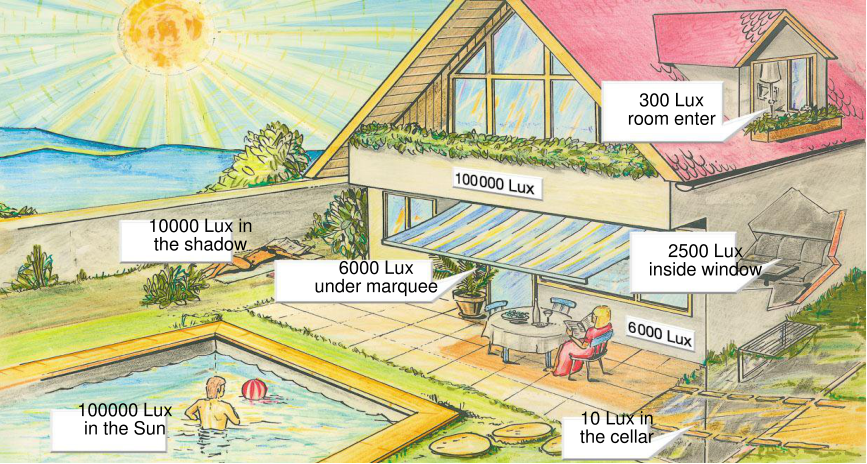
Through these specific values, the Lux “scale” allows us to precisely describe and design lighting environments.
From Sunlight to Moonlight: The Vast Range of Natural Illuminance
Nature showcases the extreme dynamic range of illuminance. At noon on a clear day, direct sunlight can produce an illuminance of up to 100,000 – 120,000 lux, an intensely bright environment that allows everything to display its most vibrant colors and clearest details. In contrast, during a moonlit night, illuminance plummets to less than 1 lux, a world dominated by monochrome vision and blurred details. From noon sunlight to midnight moonlight, the variation in illuminance spans over a millionfold! This immense range explains why our visual system requires powerful adaptive capabilities (pupil dilation/constriction) and why our perception of color and ability to resolve details change under different lighting conditions.
Illuminance and Life: More Than Just “Seeing”
Appropriate illuminance is far more complex than just allowing us to “see”; it profoundly affects various aspects of our lives.
-
Visual Health and Comfort: Inadequate illuminance is a significant factor leading to visual fatigue, dry eyes, and myopia. Excessive illuminance can cause glare, leading to discomfort and even temporary blindness. Scientifically set illuminance effectively protects eyesight and enhances comfort.
-
Work Efficiency and Safety: In places like offices, factories, and schools, sufficient illuminance improves concentration and reduces error rates. In public areas like stairs and parking lots, adequate illuminance is fundamental for preventing accidents such as falls and collisions.
-
Circadian Rhythm and Mood: Light is the most important environmental cue for regulating the human body’s internal clock (circadian rhythm). Exposure to high illuminance (especially natural light rich in blue light) during the day helps maintain alertness and boost mood; whereas excessively high illuminance at night (especially from electronic screens) can suppress melatonin secretion and disrupt sleep.
-
Commerce and Display: In museums, shopping malls, and art galleries, precise control of illuminance is used to highlight exhibits or products, create a specific atmosphere, and guide customers’ sight and emotions.
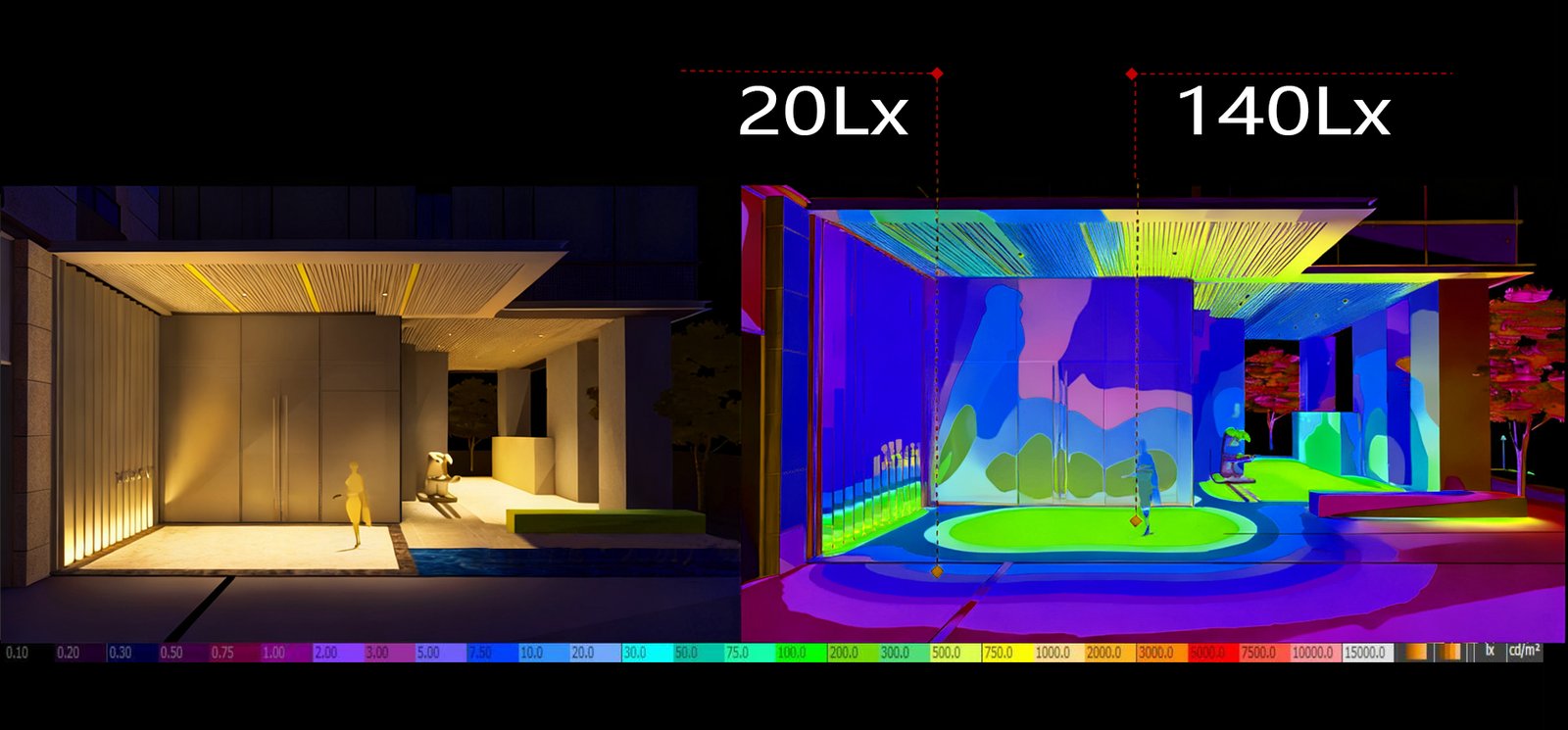
Scientific Lighting: How to Measure and Apply Illuminance
To scientifically manage a lighting environment, we first need to measure illuminance. This is typically done using an instrument called a “lux meter.” It contains a light sensor that directly converts the received light intensity into a numerical value displayed in lux.
In practical application, the following principles should be followed:
-
Distribute According to Need: Set different illuminance levels based on different activity requirements. For example, the illuminance on a study desk should be much higher than the ambient illuminance in a living room seating area.
-
Uniformity and Softness: Avoid large contrasts in brightness on work surfaces. Use indirect lighting or combine multiple light sources to make the light distribution even and soft, reducing shadows and glare.
-
Utilize Natural Light Wisely: During the daytime, prioritize the use of natural light. It not only provides high-quality, high-illuminance lighting but also saves energy and benefits people’s physical and mental health.
-
Refer to Standards: Countries have established corresponding architectural lighting design standards, providing detailed recommended illuminance values for different places such as schools, offices, and hospitals. These serve as important references for design and evaluation.
In summary, illuminance is a crucial bridge connecting light and human activity. Understanding and scientifically applying illuminance allows us to enjoy the convenience, safety, and health that light brings in every moment, from daytime work to nighttime rest.
